Never Ask “What Should I Talk About?” Again: Your Guide to Always-Relevant Video Content


You’ve blocked the time. You’re ready to record. And then, just as you hit the button, your mind goes blank. It’s not that you lack expertise — it’s that turning your day-to-day knowledge into timely, meaningful content is a skill of its own. For professionals whose value comes from answering real questions (lawyers, financial advisors, consultants, real estate experts), it can feel strangely difficult to decide which insights are worth sharing and when.
The irony is that your best content is already all around you: shifts in your industry, questions your clients ask, recurring misunderstandings, or decisions people are struggling to make. What’s hard is identifying which of those things is relevant now and shaping it into something short, clear, and helpful.
In a fast-moving environment where your audience is flooded with information, relevance is often more powerful than raw expertise. When your content reflects what people are thinking about in the moment — a new regulation, a market change, a trending issue — you immediately signal that you understand their world as it is today. That kind of alignment builds trust far more effectively than evergreen material delivered at the wrong time.
But staying consistently relevant requires a system, not constant inspiration. Here are the three components that make that system work.
1. Staying Aware Without Getting Overwhelmed
You don’t need to track every headline or absorb every industry report. You just need a simple, consistent sense of what your clients are seeing or worrying about. Often that comes from the most ordinary places: the questions people ask in meetings, the email threads where confusion keeps popping up, the conversations you see happening in your professional network.
A few targeted news alerts or weekly summaries can help, but the goal isn’t to become a trend analyst — it’s to give yourself a steady trickle of prompts that reflect the present moment. When you treat awareness as a light habit rather than a research project, you’ll notice patterns you can speak to with confidence.
2. Turning Raw Insight Into a Clear Message
Once you know what you want to talk about, the next hurdle is shaping it. Many people assume they need a polished script, but in reality, they just need clarity: What’s happening? Why does it matter now? And what do you want your viewer to take away?
A simple narrative arc — a brief hook, a bit of context, your perspective, and a closing thought — is usually all it takes. You can absolutely use an AI tool to help you draft ideas or organize your thinking, but the real value comes from your own voice and interpretation. People follow you for your judgment, not for a perfectly worded script.
3. Showing Up Consistently (Instead of Sporadically)
Most professionals don’t struggle with ideas; they struggle with time. Even when you know what to say, content creation tends to slide down the priority list as soon as real client work enters the picture. That’s why consistency usually comes from reducing the amount of effort required, not from forcing more discipline.
Some people find it helpful to record several videos at once. Others rely on a simple content calendar. What matters is creating a rhythm in which showing up becomes easier than skipping a week.
Where SmartPrompter Fits Into This
All of the friction in this process — hunting for a topic, figuring out what really matters right now, trying to shape a clean message — is something we know intimately, because we struggled with it too. AnswerStage didn’t begin with a grand plan for automation; it began with us staring at our own blank screens, knowing exactly what we wanted to say but not having the time or mental space to structure it.
We built SmartPrompter because we needed it. We were juggling client work, product development, and marketing just like many of the professionals we serve. Some weeks we had a dozen great ideas and recorded none of them. Other weeks we discovered a timely topic only after the moment had passed. The inconsistency wasn’t a lack of commitment — it was a lack of capacity.
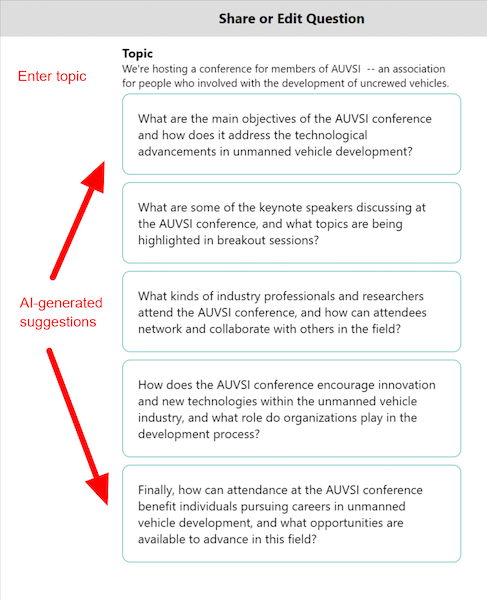
SmartPrompter is our response to that gap. It keeps an eye on the trends for you, suggests angles worth talking about, gives you a first draft to react to, and handles the polish so you can stay focused on your actual work. It’s simply the tool we wished we’d had when we were trying to create content the hard way.
Final Thought
Your audience doesn’t need perfection. They need guidance that reflects what they’re dealing with now. With a simple awareness habit, a clear message structure, and a sustainable rhythm, you can turn your everyday expertise into content that shows up at the right moment for the right people.
What’s something your clients have asked you this week? Start there.
And the next time you hit the record button, you won’t be staring at a blank screen.
The stage is yours.